REVIEW · NUREMBERG
Nuremberg World War II
Book on Viator →Operated by Suzart Tour · Bookable on Viator
Nuremberg hits hard, fast. In three focused hours, you’ll see the Nazi Party Rally Grounds and end at Courtroom 600, where the Nuremberg Trials changed how the world would think about war crimes. It’s designed as a preplanned route, so you’re not piecing together transit and tickets day-of.
I really like two things about this tour. First, the small group format (max 8) keeps the pace human, and you’ll move around in a private van instead of hunting for taxis. Second, the guide style can be very interactive and visual; one past guide, Rob, used photos sent on the spot and made the propaganda machinery feel concrete without turning it into a lecture marathon.
One possible drawback: the Palace of Justice stop costs extra (€7.50 per person) and it’s closed on Tuesdays, so your day of the week matters more than you’d think.
In This Review
- Key Points You’ll Care About
- Nuremberg’s Nazi Story, Put on a Short Timeline
- From Spectacle to Stagecraft at the Documentation Center (Nazi Party Rally Grounds)
- Zeppelinfeld: Albert Speer’s Parade Ground and One Big Surviving Landmark
- The Palace of Justice and Courtroom 600: Where the Trials Took Place
- Courtroom 600 still has a life today
- The big heads-up: admission fee and Tuesday closures
- How long should you plan for Courtroom 600?
- Price and Logistics: Is It Good Value for Nuremberg?
- Pickup in the Old Town vs. Needing the Hotel Meeting Point
- What the Guide Quality Can Change (Rob, Gabriel, Seba, and Your Experience)
- Who This Tour Is Best For (and Who Might Want More Time)
- Should You Book This Nuremberg WWII Tour?
- FAQ
- How long is the Nuremberg WWII tour?
- Where does the tour start and do you offer pickup?
- Which stops are included on the itinerary?
- Is the admission fee included for the Palace of Justice?
- Is the Palace of Justice open every day?
- What’s the group size and language?
Key Points You’ll Care About
- Private transport, small group size (up to 8) keeps the stops efficient and the questions coming.
- Pickup in the Old Town or River Cruise Port means you can start without navigating on your own.
- Courtroom 600 is the anchor stop, with extra time offered for people who want to linger.
- Documentation Center + Zeppelinfeld are free (the extra ticket is only for the Palace of Justice).
- Palace of Justice closure on Tuesdays can change everything—plan around that.
Nuremberg’s Nazi Story, Put on a Short Timeline
If you’ve ever worried that Nuremberg’s WWII sites are too spread out for a half-day, this tour is built to fix that. You get a set route with planned stops that connect the Nazi rally spectacle to the aftermath—without you needing to rent a car, coordinate a taxi, or guess where the most important remains are.
The emotional tone here is specific. You’re not just walking through ruins. You’re moving through locations tied to how the Nazi movement staged power, then transitioning to the courtroom where key leaders were prosecuted. That arc is the value: propaganda first, accountability second.
And because you’re on a tight schedule, you’ll likely feel the limits of time. Three hours is enough for the main beats, but not enough for serious “read every label” depth. Think of this as the best guided overview you can do in a single morning or afternoon—then you can add personal time if you want more.
Other Nuremberg day trips we've reviewed in Nuremberg
From Spectacle to Stagecraft at the Documentation Center (Nazi Party Rally Grounds)
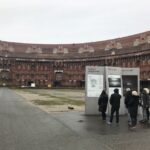
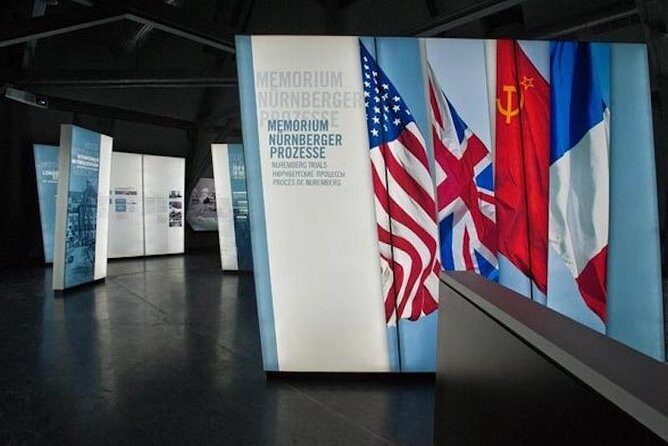
The tour starts at the Documentation Center in the Nazi Party Rally Grounds. This area was the stage for National Socialist party rallies from 1933 to 1938, and even today, the leftover scale of the space helps explain the message they wanted to broadcast.
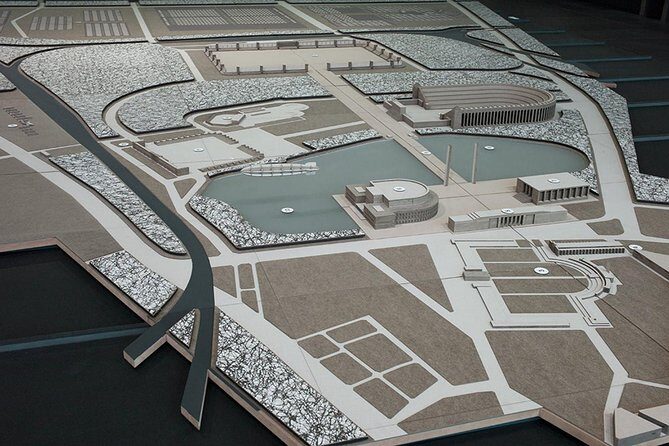
What I like about this stop is that it gives you context instead of just scenery. The exhibition lays out how the dictatorship presented itself and how the party rallies were organized and produced. You’re also looking at a site covering about 4 square kilometers, so the guide’s framing helps you understand that you’re not seeing a single monument—you’re seeing a whole propaganda infrastructure.
Practical note: this stop includes admission (free ticket) and runs about 1 hour. That’s a good amount of time to get your bearings. If you prefer to absorb slowly, you’ll still get the main ideas, but you may find yourself wanting another pass later—especially if you read deeply or like to compare what you see outside with what the exhibit shows inside.
Zeppelinfeld: Albert Speer’s Parade Ground and One Big Surviving Landmark
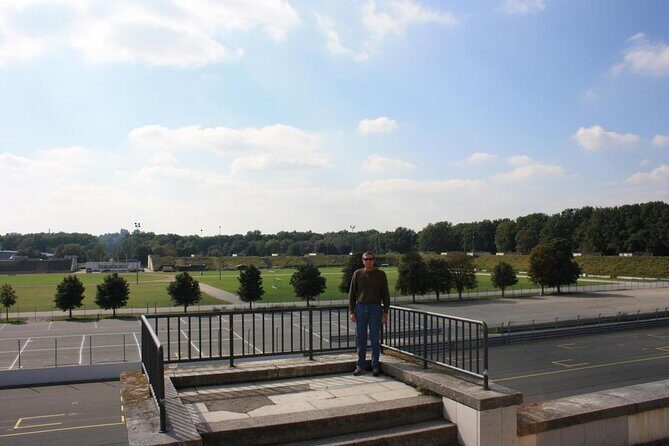
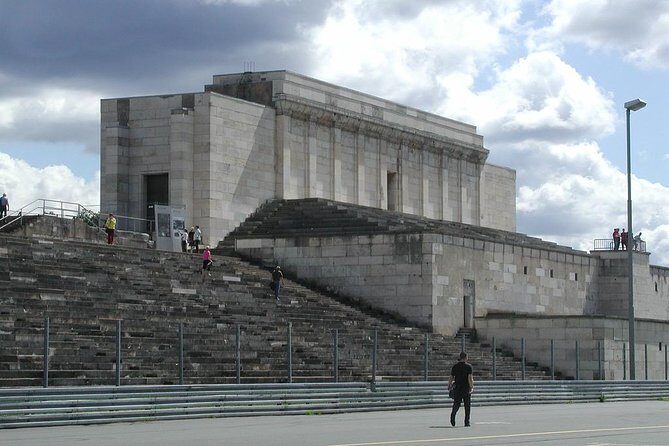
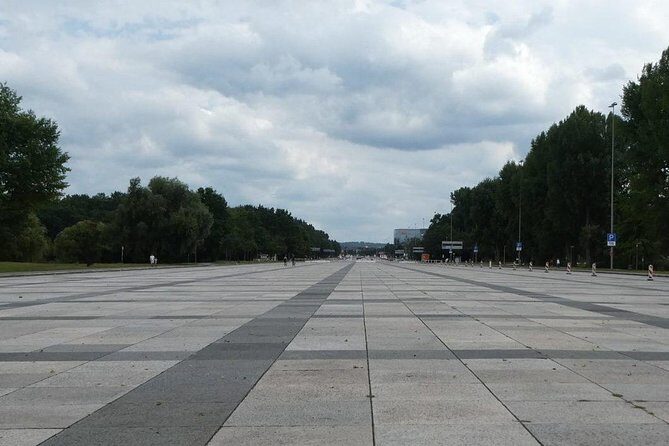
Next up is Zeppelinfeld, the Zeppelin Field. Here, the space is tied to a specific design period: between 1935 and 1937, the Zeppelinwiese was redesigned using a plan by Albert Speer (1934). You’ll be looking at a parade grounds setup with grandstands, meant for massive coordinated performances.
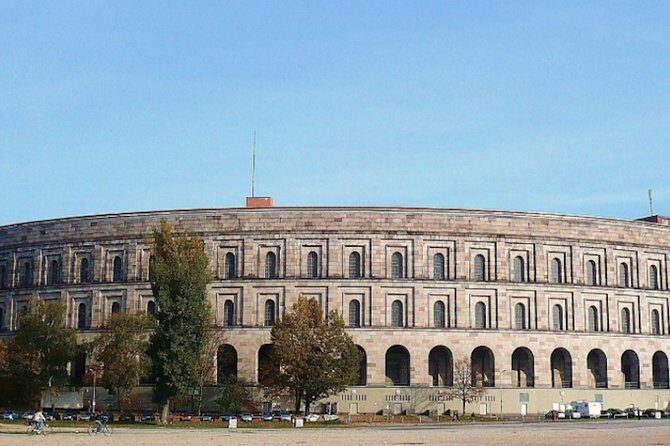
One detail that helps make Zeppelinfeld memorable: it’s described as the only completed building on the Reichsparteitagsgelände. That means what you see isn’t just “a space where rallies happened.” It’s a remnant of the plan that actually reached completion—so it carries extra weight when you compare it to what didn’t survive or wasn’t finished.
This is a short stop—around 20 minutes—and it’s free. That short timing is a feature, not a flaw. Zeppelinfeld works best as a quick, visual bridge between the Documentation Center’s explanation and the courtroom stop that brings the story to its consequences.
The Palace of Justice and Courtroom 600: Where the Trials Took Place
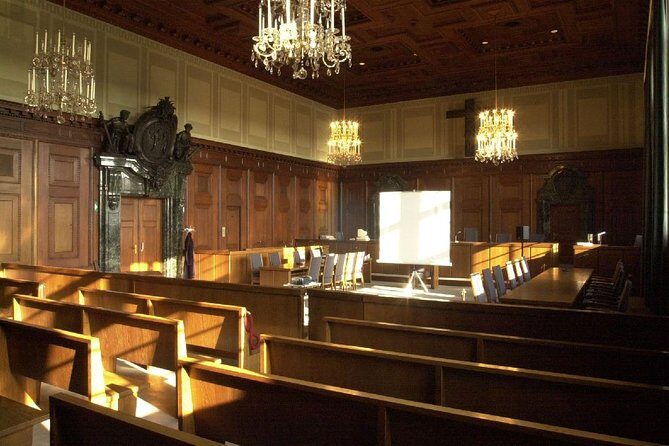
This is the heart of the tour for most people: Nuremberg Palace of Justice and especially Courtroom 600 in the eastern wing of the building.
A key piece of context: the trials ran from 1945 to 1949 for the main surviving German war criminals of World War II. The choice of Nuremberg wasn’t random. The Nazis had held huge Nuremberg rallies here, so using the city and its judicial setting was symbolic—revenge with paperwork.
Why this building matters even beyond the famous courtroom: it was chosen because it was almost undamaged, had enough space for the proceedings, and included a large prison complex. In other words, it wasn’t just dramatic—it was practical enough to function as a real trial site.
Courtroom 600 still has a life today
Courtroom 600 is still used, particularly for murder trials. During the Nuremberg Trials, the courtroom was reconfigured to create more space, including a wall being removed temporarily. After the trials, the courtroom was refurbished: that wall was re-erected, and the judges’ bench was turned 90 degrees. It’s now positioned where the witness box was during the trials.
If you’re the kind of visitor who likes to understand why a place feels the way it does, these specifics matter. It’s not “a room that happened to matter.” It’s a room that was physically changed for history, then changed back.

The big heads-up: admission fee and Tuesday closures
Here’s the part that can make or break your expectations:
- Admission fee is not included for the Palace of Justice: €7.50 per person
- The Palace of Justice is closed on Tuesdays
If your travel dates land on a Tuesday, you might lose the courtroom experience entirely. That’s not the tour’s fault—this is just how the site operates. If you can, schedule your tour for any other day so the Courtroom 600 stop can happen as planned.
How long should you plan for Courtroom 600?
The tour description allows about 1 hour at the Palace of Justice area, and there’s typically an option for extra time in Courtroom 600 if you want it. Several people recommend using the chance to linger, because the significance doesn’t compress well into a quick photo-stop.
But here’s the tradeoff: in a short overall tour, adding time in the courtroom can crowd out time elsewhere. So if you want the courtroom to be your main focus, lean into it and don’t rush. If you want a bit more breadth across the rallies, stay aware that there’s a fixed overall schedule.
Price and Logistics: Is It Good Value for Nuremberg?
At $91.71 per person for about 3 hours, the value depends on how you feel about two things: convenience and the extra ticket.
You’re paying for:
- Driver-guide + private transportation
- A route that hits the main WWII-era sites efficiently
- English-guided interpretation
- A small group pace (max 8)
You’ll also need to budget:
- €7.50 per person for the Palace of Justice (Courtroom 600)
Meanwhile, the other two stops are free (Documentation Center Nazi Party Rally Grounds and Zeppelinfeld). That’s a helpful cost structure. Most of your sightseeing time is built on free admission locations, and the paid component is concentrated on the single most important courtroom moment.
So is it “worth it”? I think it’s a strong deal if:
- you want a guided route without handling transit,
- you don’t want to figure out which sites matter most,
- you’re okay with a short tour format that prioritizes the key stops.
It’s less ideal if you want hours and hours inside exhibits with no time pressure. This is a fast, high-impact overview, not a full self-guided research project.
Pickup in the Old Town vs. Needing the Hotel Meeting Point
Logistics are one of those invisible reasons tours succeed or fail. Here, pickup is designed around convenience.
If you’re staying in Nuremberg Old Town or at the River Cruise Port, pickup is offered there. If you’re outside the Old Town, you’ll need to go to the pickup location at Novotel Hotel Centre Ville, Bahnhofstrasse 12.
A practical tip: on a short tour like this, you don’t want to “arrive at the right station and figure it out.” Give yourself cushion time for getting to the pickup spot, especially if your hotel is outside the pickup area.
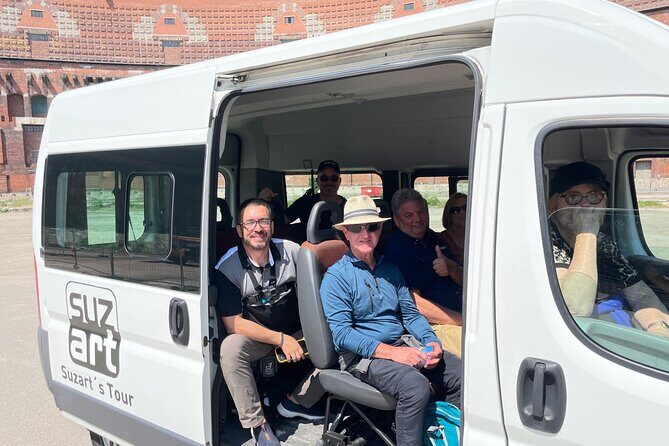
The van ride itself is usually part of the comfort factor. A couple of past experiences highlighted that the vehicle was clean and the group got enough time to settle in, and that matters more than you’d expect when the topic is heavy and your brain needs a steady flow of context.
What the Guide Quality Can Change (Rob, Gabriel, Seba, and Your Experience)
One thing that comes up often is the impact of the guide’s delivery style. A guide can make the rally grounds feel like a story you can follow instead of a list of names and dates.
From past guides mentioned in this tour’s feedback:
- Rob was described as lively and prepared, including using photos on the spot to show what the locations looked like in Nazi Germany times.
- Gabriel was praised for strong communication and context across WWII, with very clear handling of pickup timing.
- Seba was noted for seeing the big Nazi rally space as more than a quick photo moment.
Not every style works for every person. If you have strong preferences for slow, detailed interpretation, remember this is still a short tour. The guide will keep the pace moving so you hit Courtroom 600.
Also, if you’re sensitive to English speed or accents, it’s smart to know that some people found it easier than others. If you rely on hearing patterns to follow details, sit in a spot where the guide’s voice carries well and don’t be shy about asking for clarification.
Who This Tour Is Best For (and Who Might Want More Time)
This is ideal for:
- first-time Nuremberg visitors who want the most important WWII sites in a short window,
- travelers who don’t want to drive or sort out tickets and transport on their own,
- anyone who values getting the courtroom context alongside the rally grounds.
It might not be perfect for:
- people who want long museum time at the trial materials without time pressure,
- visitors who want a deep, start-to-finish history of the city’s Nazi-era growth in one sitting,
- travelers who are going on a Tuesday (because the Palace of Justice is closed).
If you fall into the “I want deeper study” group, you can still use this tour well. Get the guided overview first, then add extra time to the places that grabbed you most.
Should You Book This Nuremberg WWII Tour?
Book it if you want a tight, guided route that connects the Nazi rally spectacle to the Nuremberg Trials without requiring you to manage logistics. The small group size and private transportation are real quality-of-life perks, and the structure is set up to make Courtroom 600 feel like the main event.
Don’t book it (or at least re-check plans) if:
- your dates are Tuesday and you were counting on the Palace of Justice,
- you’re expecting hours inside exhibits with no schedule pressure,
- you’d rather spend the money on self-guided time instead of guided context.
If you do book, do one thing that makes the experience better: plan your day around the courtroom stop. Then use the rally grounds as the context you’ll carry in with you.
FAQ
How long is the Nuremberg WWII tour?
It runs about 3 hours (approx.).
Where does the tour start and do you offer pickup?
Pickup is available in Nuremberg Old Town and the River Cruise Port. If your hotel is outside the Old Town, you’ll need to go to Novotel Hotel Centre Ville, Bahnhofstrasse 12.
Which stops are included on the itinerary?
You’ll visit:
- Documentation Center Nazi Party Rally Grounds
- Zeppelinfeld
- Nuremberg Palace of Justice (Courtroom 600)
Is the admission fee included for the Palace of Justice?
No. The Palace of Justice admission is €7.50 per person and is not included. The other two stops are listed as free tickets.
Is the Palace of Justice open every day?
No. The Palace of Justice is closed on Tuesdays, so that stop may not be available on those days.
What’s the group size and language?
The tour is in English and has a maximum of 8 travelers.