REVIEW · MUNICH
Medieval city tour with night watchman in Munich in German
Book on Viator →Operated by schwarzgold.info · Bookable on Viator
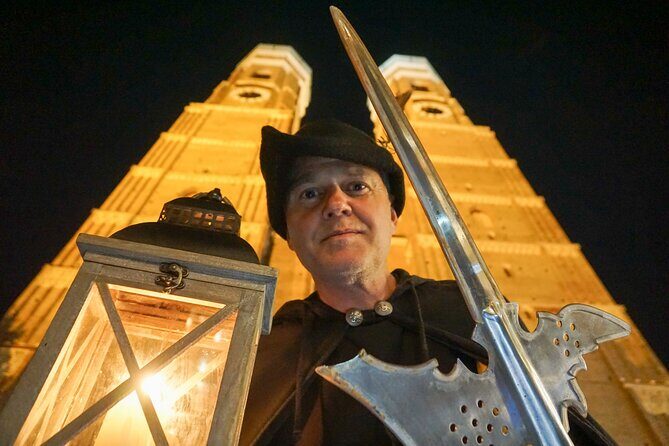
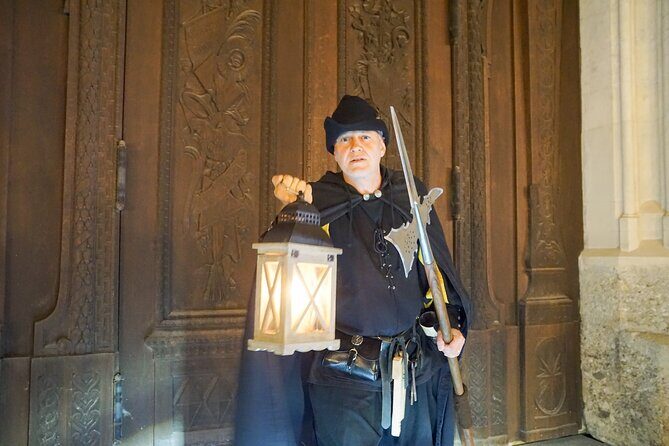
Wolfram turns Munich into a night stage. This 90-minute walk follows an original night watchman role, complete with a lantern, halberd, and horn, so the city’s medieval daily life feels concrete, not like a textbook. I like the way the route anchors big themes—night watch duties, gates, and punishment—right on top of real places you can still see.
I love the storytelling tone: serious facts, but with humor that keeps the dark topics from feeling lifeless. You’ll hear about an execution, the poor sinner bell at St. Peter’s, medieval cemeteries, torture and a dungeon prison, and even how debts worked with a tally stick. One thing to consider: this tour covers grim medieval subject matter, so it may not be ideal if you prefer purely light sightseeing at night.
The group stays small (up to 10), it runs at 8:30 pm, and you’ll move from Marienplatz through old streets toward the end near Kaufingerstraße. You use a mobile ticket, and you’ll get a tour that’s built for a brisk evening pace—about 5 to 10 minutes per stop—so you get variety without feeling stuck in one place.
In This Review
- Key things I’d watch for
- Why Wolfram’s night watchman tour feels different in Munich
- Price and timing: good value if you like story-driven walks
- Meeting point near Marienplatz: how to arrive without stress
- Marienplatz to St. Peter’s: starting the watch and hearing the city’s signals
- Medieval cemeteries and why the altar mattered
- Viktualienmarkt and the first city wall: learning to spot defense in plain sight
- Burgstraße dungeon tales: prison, torture, and medieval punishments
- Münzstraße and real silver pennies: money as power
- Alter Hof and Wittelsbach family clues: the strict duke in context
- Closing the gates at Dienerstraße and Weinstraße
- Schäfflerstraße and the tally stick: learning debt the medieval way
- Frauenkirche in 20 years: the scale you can’t miss
- Finishing at Frauenplatz and Kaufingerstraße’s Beautiful Tower
- Practical tips: what to wear and how to handle the “good weather” rule
- Who should book Wolfram’s night watchman tour?
- Should you book this Munich medieval night watchman tour?
- FAQ
- What is the duration of the medieval city tour with night watchman Wolfram?
- How much does the tour cost?
- What time does the tour start in Munich?
- Where does the tour start and where does it end?
- How many people are in the group?
- Is the ticket mobile?
- Is the tour offered in German?
- What happens if the weather is bad?
- Are service animals allowed and is public transportation nearby?
Key things I’d watch for
- Small group size (max 10): easier questions and a more personal feel at each stop
- Night watchman performance style: lantern, halberd, and horn turn history into action
- Stops tied to specific medieval jobs: gates closing, punishment locations, and street addresses
- Real-world medieval artifacts: medieval silver pennies and the tally stick story
- Dark-but-explained topics: execution, torture, and prison are part of the route
- Cold-weather reality: it’s an evening tour, and you’ll be outside for the whole loop
Why Wolfram’s night watchman tour feels different in Munich
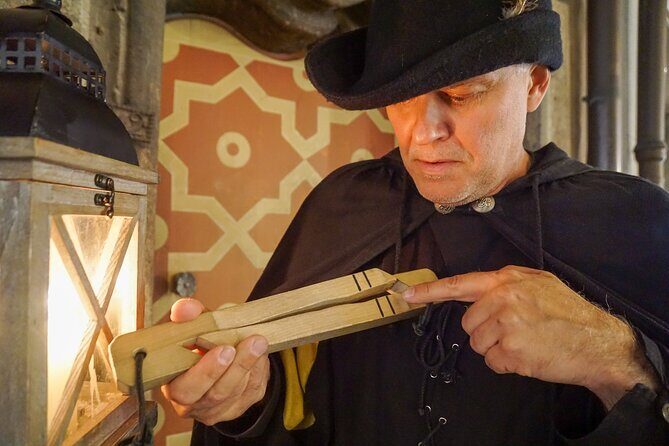
Most city walks give you dates and names. This one gives you a job. Wolfram the night watchman moves through medieval Munich like he’s on duty, explaining what the night watch actually meant—how the city stayed safe, what it meant to guard gates, and how punishment and fear fit into everyday order.
That role-play matters because it changes how you see familiar landmarks. Marienplatz stops being just a square and becomes a place where night duty begins. Churches and courtyards stop being only pretty architecture and start acting like medieval tools—signals, rituals, and locations tied to community life.
Two details I’d put near the top of your “why this is worth it” list: you’ll get a guided sequence of medieval city walls and gates, and you’ll also see money and debt mechanics through Wolfram’s perspective, including original silver pennies and the tally stick topic. Those are the kinds of stories that make history feel usable, not distant.
Other Munich city tours we've reviewed in Munich


Price and timing: good value if you like story-driven walks
At $16.13 per person for about 1 hour 30 minutes, this is priced like a solid city tour add-on. The value comes from three things working together:
- You’re not paying for “views only.” You’re paying for a guided narrative built around specific medieval roles.
- The stop-to-stop format keeps it moving, so you get several themes in one evening.
- The max of 10 people helps keep the flow from turning into a lecture.
You start at 8:30 pm from Rathaus Apotheke, Marienplatz 8 (80331 München). That start time is a sweet spot for a night-tour experience without being too late for most people. It also means the city feels different—streets and squares read more like night spaces than noon spaces.
If you’re short on time in Munich but want something that isn’t the standard “Old Town highlight” loop, this is a strong candidate.
Meeting point near Marienplatz: how to arrive without stress
Your start point is Rathaus Apotheke, Marienplatz 8, 80331 München. You finish at Hirmer, Kaufingerstraße 28, 80331 München. Both are central, and the tour is noted as near public transportation, so you should be able to reach it easily from wherever you’re staying.
My practical tip: aim to be there a few minutes early. It’s a small group, and the evening start means you don’t want to be the person sprinting in cold air while trying to catch up.
Also, plan the rest of your night with a little buffer. With multiple short stops, you’ll move steadily across central Munich, and you’ll likely want time afterward to warm up or grab a quick bite near the finishing area.
Marienplatz to St. Peter’s: starting the watch and hearing the city’s signals
The tour begins at Munich Marienplatz, where Wolfram welcomes you and sets the scene: what night watch duties were in the Middle Ages. This is the foundation moment, because once Wolfram explains the job, you’ll “read” the rest of the walk differently.
From there you head to St. Peter’s Church. Wolfram shows the poor sinner bell and demonstrates an execution of Marco Bragadino. That’s a key part of the tour’s tone. You’re not just seeing a building; you’re hearing how communities used sound, ritual, and public punishment to enforce order.
What I like here is how it’s tied to one location rather than spreading vague horror across random stops. It stays connected to place.
Possible drawback: if you’re sensitive to execution/torture topics, the St. Peter’s portion may feel heavy early on. It doesn’t change your understanding—but it affects your mood.
Medieval cemeteries and why the altar mattered
Next comes Petersplatz, where you visit the medieval cemetery. Wolfram explains why people wanted burial as close as possible to the altar.
That detail might sound small, but it changes the whole feel of a cemetery. Instead of thinking only of death and sadness, you start seeing how burial proximity tied into belief, community standing, and spiritual hope—practical reasons wrapped in faith.
This stop is also a good reset. You’ve just covered a bell and an execution, and now the tour shifts toward how people lived with religion at the edge of everyday life.
Other Night Watchman tours we've reviewed in Munich


Viktualienmarkt and the first city wall: learning to spot defense in plain sight
At Viktualienmarkt, you learn exactly where Munich’s first city wall stood. This kind of stop is why I think this tour earns its name. Once you hear where the wall was, you can look at the surrounding streets and imagine the city as a protected shape, not just a map of shops and cafes.
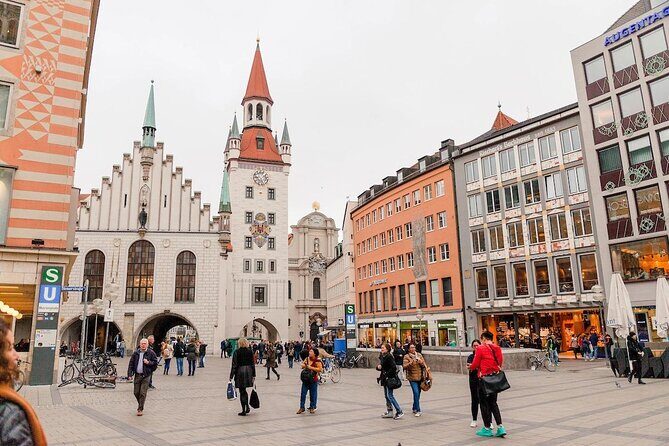
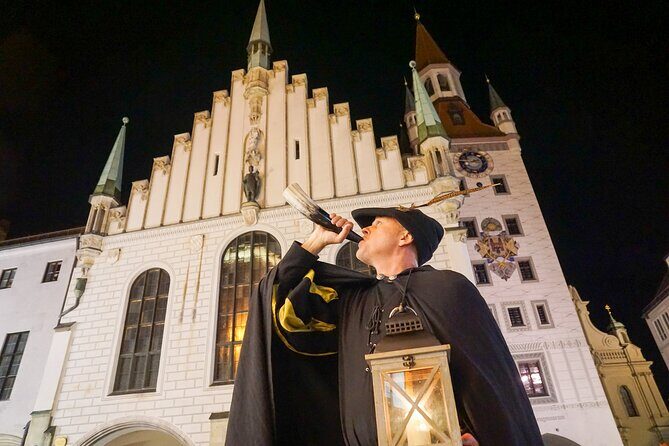
Then you move to the Old Town Hall, where Wolfram closes the Talburg gate and shows you the medieval halberd. This is another “job” moment—he’s not only telling you what existed, he’s acting it out as a guard might.
If you like history you can picture, this section is strong. You’ll understand the logic of gates: controlled access, watch routines, and the physical barrier between inside and outside.
Burgstraße dungeon tales: prison, torture, and medieval punishments
On Burgstraße, the tour turns toward the medieval prison in Munich: the dungeon, torture, and what punishments existed in the Middle Ages.
This is the part of the route that makes the tour feel most like a dark theater performance. Wolfram connects these stories back to how a city enforced rules at night—when the world was quieter, and control had to be more visible.
It’s also where you’ll learn what kind of system a walled medieval city ran, beyond “there were soldiers.” You’ll come away with a clearer sense of how fear and discipline were built into the urban order.
Again, consider your comfort level. The tour includes these topics by design, and it doesn’t try to sugarcoat them.
Münzstraße and real silver pennies: money as power
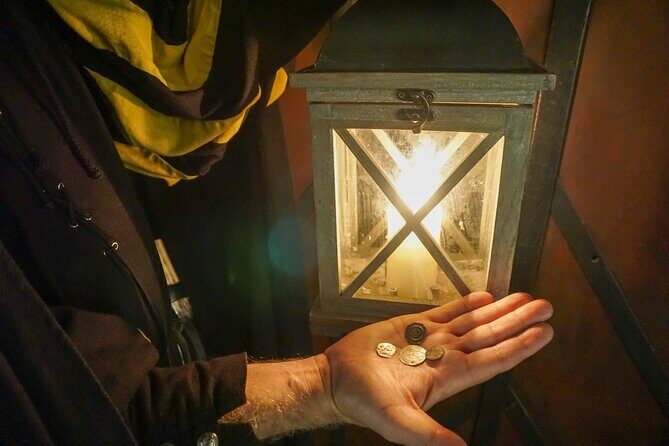
In Münzstraße, Wolfram lets you look into his purse and shows original silver pennies from the Middle Ages. That’s one of the most satisfying types of history stops: you can visually connect what you’ve heard to actual objects.
From there, the story expands into economics and daily survival. You’ll also hear about debt mechanics later with the tally stick, but even here the idea lands: money wasn’t abstract. It was tangible, regulated, and tied to power.
Alter Hof and Wittelsbach family clues: the strict duke in context
At Alter Hof, you experience the first castle the Wittelsbach family built in Munich, and Wolfram explains why Duke Ludwig was also called the strict one.
This is a calmer historical angle. You move from punishment spaces to the kinds of authority structures that created them. It’s a useful reminder: medieval city life wasn’t only about night guards and punishment. It was also about ruling families and power consolidation.
If you like “who built what, and why people followed,” you’ll get a lot from this stop.
Closing the gates at Dienerstraße and Weinstraße
At Dienerstraße, Wolfram closes the Vorderes Schwabinger Tor and explains what remains still remind you of the first city wall. Then at Weinstraße, he closes the Rear Schwabing Gate and explains how addresses used to work.
The address explanation is a clever way to make history feel practical. You start thinking: how did people find each other in a city that wasn’t organized like modern street numbering?
This pair of stops gives you structure. By the time you reach them, you’ve heard about walls, gates, and city control. Now you see how people oriented themselves inside that system.
Schäfflerstraße and the tally stick: learning debt the medieval way
In Schäfflerstraße, you learn how people got into debt using the tally stick, and Wolfram has his and explains how it worked.
This is one of those details that sticks because it’s so different from today. You get a concrete idea of how record-keeping and credit could go wrong when the system depended on physical tokens and counted obligations.
If you’re the type who enjoys economic history—how systems create outcomes—this stop is a winner.
Frauenkirche in 20 years: the scale you can’t miss
The tour ends with big architecture and quick explanations. At Frauenkirche (Women’s Church), you’re impressed by its size, and Wolfram explains how it was possible to build this church in just 20 years.
That’s a striking number, and it helps you look at the church with a different mindset. Instead of only admiring it, you start imagining the coordination behind it: labor, planning, and commitment.
This is also a good emotional shift. After prison and punishment stories, the tour gives you an impressive human achievement—something that still shapes Munich today.
Finishing at Frauenplatz and Kaufingerstraße’s Beautiful Tower
At Frauenplatz, you discover which medieval traces still remain in the old town. Then at Kaufingerstraße, Wolfram completes the Beautiful Tower and says goodbye to you.
This ending matters because you leave with a sense of continuity. You’re not only hearing about what vanished—you’re learning how remnants show up in your walking route.
One extra detail that helps the mood: Wolfram’s humor can be part of the finale energy. In one instance, he even plays with naming roles in the night-watch world, like appointing Friedrich to a lantern-related nickname. It’s the kind of character touch that keeps the evening from becoming too grim.
Practical tips: what to wear and how to handle the “good weather” rule
This tour requires good weather. If it’s canceled due to poor weather, you’ll be offered a different date or a full refund.
That means you should plan as if you’ll be outside for the whole experience. Reviews also point out how cold it can feel, even when the stories are great—so I’d dress like it’s going to be chilly. Layers help. A hat and gloves can save your evening.
You’ll also want shoes that handle normal walking on central streets. The route is a sequence of short stops, but you’ll still cover enough ground to feel it if you’re in flimsy footwear.
The ticket is mobile, and service animals are allowed. Near public transportation is a plus, especially for an 8:30 pm start.
Who should book Wolfram’s night watchman tour?
Book this if you want history with movement: gates closing, places turning into roles, and stories that connect medieval life to the city you can see right now.
It’s especially good for:
- First-time visitors who already know the “top sights” but want something different
- People who like a strong guide voice and a small group dynamic
- Curious walkers who enjoy medieval punishment, law, and social order stories (with explanation, not shock value)
It may not be the best fit if:
- You strongly prefer light, only-positive sightseeing at night
- You’re not comfortable with execution/torture/prison topics
Should you book this Munich medieval night watchman tour?
If you like story-driven walking and can handle darker medieval topics, I think it’s a smart booking. The price is low enough that it won’t feel like a risky splurge, the group stays small, and Wolfram’s role-play approach makes the route feel purposeful instead of random.
My final check before you book: bring warm clothes and go in expecting a medieval world that includes punishment and fear, not just knights and pretty churches. If that matches your travel style, you’ll get a memorable night walk that helps Munich’s medieval shape click into place.
FAQ
What is the duration of the medieval city tour with night watchman Wolfram?
The tour lasts about 1 hour 30 minutes.
How much does the tour cost?
The price is $16.13 per person.
What time does the tour start in Munich?
The start time is 8:30 pm.
Where does the tour start and where does it end?
It starts at Rathaus Apotheke, Marienplatz 8, 80331 München, Germany, and ends at Hirmer, Kaufingerstraße 28, 80331 München, Germany.
How many people are in the group?
The tour has a maximum of 10 travelers.
Is the ticket mobile?
Yes, the tour uses a mobile ticket.
Is the tour offered in German?
The tour is described as being in German.
What happens if the weather is bad?
The experience requires good weather. If it’s canceled due to poor weather, you’ll be offered a different date or a full refund.
Are service animals allowed and is public transportation nearby?
Service animals are allowed, and the meeting point is near public transportation.